
~recording carol anne. lchristopher. [sci-fi appear, previously published in dowser's wand monthly and The Jaunt].
[fuck me ray bradbury; rod serling, heinlein, baker, love you. picture if you will an author, writing for his very life. there's a signpost up ahead, the next stop - the twilight zone].

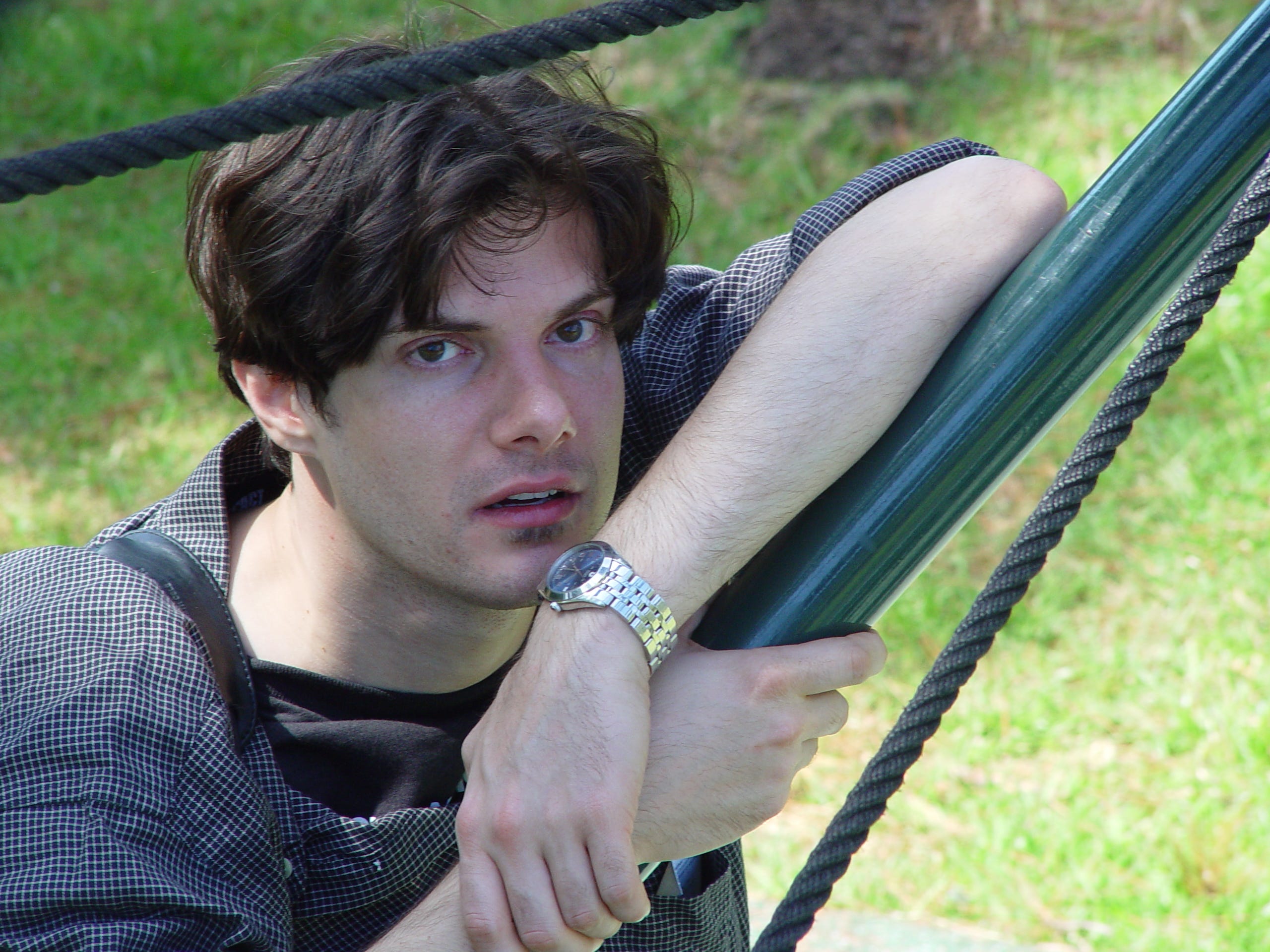
~berkeley california, author photo; with thanks to whoever the publisher hired that day. drove all night from SE Main, PDX.
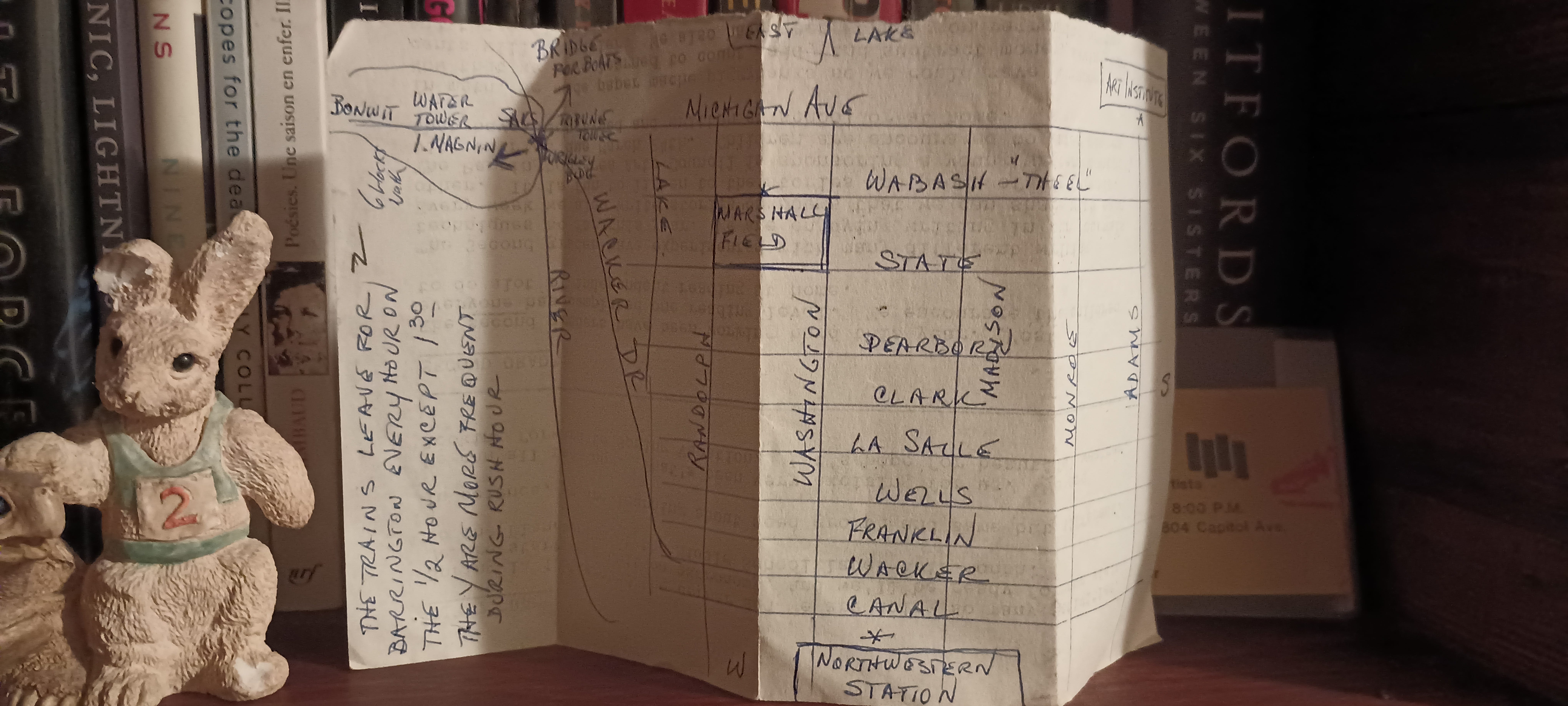
~favorite bookshelf; home library, hand drawn map as found between pages without number.
--------------------
Recording Carol Anne. lchristopher.


This is a recording.

Today was the day it happened. Love blew apart and swallowed the world.

The agency stretched for a square mile underground. It had taken six governors
and the detour of three subways nearly four blocks to do it. It was government
architecture and looked it. Four feet of steel and reinforced concrete with two inches
of lead shielding between each layer. It was as sterile as a dentist’s office and as motile
and abuzz as a courtroom awaiting verdict.

Thoughts like these always begin inside a room.
Here the cells were lined in velvet, the answers written on the walls in fingernails and blood. Census Control, the commute wasn’t hard.  Simon threw his scarred buffalo attaché under the desktop and punched up last night’s recording, and the one that was made earlier that morning. Number #47A035. Anne Margaret, first name Carol. Pretty stock photo, blonde. Torn jeans, mock-halter top, off-white. No handbag. No keys. Her apartment had yielded nothing.

He opens the blinds, driving out the sodium-arc glare. The sun skipped over her pages in the dossier. Assigned to himself as supervision over Dascend Thomas and Peter Oshinksy. Peter was a good man. Dascend and he had their reservations about working with each other. Hopefully Peter would manage the balance on this one. The coffee tasted like it was filtered through an old sock. Monday.

Four walls into a Creamsicle-hued oldbook left on the red-leather ottoman. Carol Anne watches from her terrace. Wrought iron grilling bare feet in the sub-autumn winds, ivy and wisteria crawling through the spaces inbetween her toes. In Boston. This is where they had telephoned outside 12 hours ago, claiming there was a delivery. They had taken her on the street. He has read her dossier, the notes in the clamfolder parked off to the side, he knows what she is going to say almost before she does.

Simon Rader unlocks her cell with a slashcard. Inside is a room of plush velour, brass
candelabras, television with exclusive programming. Her hair is short and knotted. Her fingernails are unlacquered and short like dandelion seeds. She is dressed in blue jeans and a blouse, off-white. Her nipples are not quite erect. These things are not
important. These things are all this woman has in the world.

Anne Margaret, Carol looks at his off-the-rack coat and tie, the non-descript four-door sedan he doubtlessly drove to work from a tract home that had been primed from a development with dozens exactly like it. He is a Census Taker, and as such a copy of himself and the System and therefore exactly what she has primed herself against. He knows what she is thinking. He has done this thousands of times.

"My name is Carol Anne. I live in Boston, on Newbury Street. On the BackBay."
The Back Bay is not by the south side, and not really the north, Simon Rader thought, as easy as you please.
"Not by the south side. The North is further away than the south, and vice
versa," she said.
She’s twenty-three or twenty-six. I can’t see it clearly. Not yet.
"I'm twenty-three. Oh, but that's what I tell people. They think that I am older
than my years. Do I look old to you? Or are you not supposed to answer?"
Simon Rader smiled spitlessly and said nothing. It was the smile of a leper.
"Twenty-six. On my birth certificate. attended college. I went to Strathmore. went directly into early admission..."

around.
I lost my birth certificate when I
Three years. I left high school early and
There didn't seem much reason to be sticking

Carol Anne Margaret believes these things, not necessarily because they are
true, but because she believes that they are. The polygraph draws thin wavering lines
in an old man's hand across the slip-sheet. Simon lets her speak. Even the hangmen
will toss their own necks over the side this way. He has been doing this for a very long
time. These rooms have held soldiers, senators, statesmen, ambassadors, plenipotentiaries, and once a King. All had broken. The King had been the easiest, he remembered. That was a disappointment, Simon Rader thought, and shot his cuffs reflexively.

He was the best they had.

Did they hurt you? Simon said, shuffling his papers. In his mind: I am about to
throw this all away. Am I certain? Yes. Yes, I do believe I am. She laughs. As if to say, I’m not stupid to your good-cop-bad-cop routine.
Which Simon thought, it is.
Fresh-cut flowers, he is thinking. You buy fresh cut flowers every Tuesday. Your father
used to and now you do.
He gestures towards the dandelions. “They’re beautiful.”
“Once these were weeds,” she said, and puts her legs up on the table. The audacity. You little bitch.

She is twenty-six years of age. Her driver’s license number is #001974318012. She
has a birthmark on her ankle and a tattoo on the bridge of her foot of a blue Egyptian sun (age 16). The aureole of her left breast is pierced with a steel ring of a moderate gauge (age 22). He can see how the cloth on her blouse is molded against the metal (present day).

No brassiere, he thinks. You can be arrested for that.
Her face is bruised, an aubergine patch sheathing one of her wet blue eyes. Dascend,
you bastard.
“Where am I?” she asked.
“Manhattan Island.”
“New York City?”
He nods.
Now she'll ask why, he thinks. But she doesn’t. She gets up to fetch the crystal pitcher from the endtable. She fills it from the kitchenette and then returns to a stack of yellow blossoms that are stirring in bloom on the desk near her bed.

“How long will I be here, do you think?”
“That depends on you, I would guess. Why?”
“I’d like to get my recipes.”
“We have a chef here.”
“It’s not the same when someone else cooks for you.”
"Um," said Simon, who had never cooked in his life. The Automat down the
street made chipped-beef on toast. He had been eating there for seventeen years.
“I suppose I should ask what exactly it is that you want,” Carol Anne Margaret said coolly, crossing her legs and pushing back from the scarred interrogators tabletop, eyes defiant and staring him down. From below, he thought. Was that even possible? The regs said different. Everything said different.

Here’s where a career becomes a non-sequitur, Simon thought, and plunged.
He pressed the button in his hand. Inside the think-room recorders were scribbling
gibberish and their video feeds could not read their lips from this angle. Now they were frozen mid-stenograph. The whole world was watching. Here goes everything.

“What I want, and what they want, are two entirely different things.” He
withdraws a photograph from a plain manila envelope and passes it across the table to
her. It is a large 8x10, black and white. It has been framed in a gilt-edged gold to
protect it. He had taken it himself with a single-lens reflex camera and developed it in a toilet bowl on the fiftieth floor that no one knew about. It was akin to smiling when
waiting for the image to swim out of the ether. It was damn near alchemy. The
process probably hadn’t been done in a hundred years. Not now when there were so
many ways to fall and the Null Electronic Act had been affected. All analog was considered theft. Animal, vegetable or mineral. Digital carried the day.

The photograph was of a device that time had forgotten.

“This was taken at your apartment.”
“Where did you get this?” she said, deflecting, unaccusatory. “A museum?”
“Never mind the picture. Concentrate on what’s in it.”
“I’m not sure I understand." Wiggling out of his interrogation.
“Look close. The box. The wooden box on the dresser.”
“There was a shooting. That is why they sent for me, they said.”
“I’m not interested in him. I’m interested in the phonograph.”
“The what?”
“The phonograph.”
“I don’t have a seismograph. You’ve gone mental.”
“The phonograph,” Simon enunciated. “The gramophone, the record player. The phonograph.”
She seemed to digest this for a moment. Her eyes raced. He had her. He had
come this far. There were tools if he needed be. The kind interrogator dentists used
on your eyes when you’d done wrong.
“Tell me.”
“So you can kill me?”
“I don't d-”
“That photograph is illegal,” she said. It was not a question.
“Never mind that.”
“The frame too.” She, musing, now.
“You are a Museum? You?” she laughed. Are you a friend of Bob? sub-groups of self-restraint early in the latter century. A museum. Drinkers used to ask that in their 12-step departments. A Museum is a man drunk on the past. A man who holds onto history illegally.
“Yes.” It was barely a whisper.
“YOU? A CENSUS TAKER?”
“Not so loud, goddamn you! The cameras are off and the bugs are paused on Halloway but there’s nothing wrong with their ears or their eyes. Act normal. Stop asking me questions and start answering some. Now. Does it work?”

Simon Rader thought for a minute he had lost her, that the hook had been chipped off by her teeth, that the line had been miscast. And then suddenly, unbelievably, she was
there. And what she knew was his once more. The way it was meant to be.
“I’veneverusedit,” she said, all at once, and he didn’t think she was lying. Simon had no
idea how finite these things were. Perhaps you could get ten uses out of a record
player. Maybe twenty.
“Never mind that. Does it work?”
“It takes power. It switches on.” Simon’s heart leapt in his chest. He couldn't be so lucky.
“Where did you get it?”
“My mother’s mother had left it for me. She was an antique dealer. Is that what you’re into?Antiques?”
“No. I am into anathema.”
“What?”
“Memory, Miss Margaret.”
“How do you know my name?” Her eyes traced the walls, the cameras, the
seams, the velvet and the velour.
“I am good at what I do.” He shrugged.
“And that would be?” he felt those invisible fingers prying/trying at his forebrain. They hadn't unlocked him yet. Give enough time, and she would. She was already locked on to his PES - his personal emotional script. Everybody had one. Even Census Takers.
Simon smiled and said nothing. “Can I get you anything?”
“A real cigarette. Tea. Something to read.”
“All right,” he said, closing the door behind him.
In the control room, Dascend was smoking a cigarette and repetitively bouncing a Go-Ball
against the outside of her wall, snapping his wrist back, THUMP, catching it on the
rebound. It was damned near mechanical and unnerving. Simon catches the ball in
mid-slice and pockets it without breaking stride.

“Protocol much?” Peter said, his eyes smiling.
“I can’t think when he does that.”
“What did you make of her?” Dascend asked.
“Cute girl. Seems intelligent.”
“She’s about as fashionable as a scab, Simon,” Dascend said.
“She was probably a lot better looking with both of her eyes open. I supposeyour reason for decking her will be in your report.”
“Just doing my job,” Dascend replied, then thought a minute. "Sir. And for the
record, it’s probably going to be a bust. She doesn’t seem to know anything of value.”
“Did you get anything, Simon?” Peter asked, looking up from his lunch of veal
and tomato cabbage. It was appealing as the ribcage of a mouse pulled open and pinned to an emery board.
“I’m not sure,” Simon said, but he was thinking of the girl. The girl and her great-great grandmother's Victrola. They used steel needles in those days. Was the needle any good? Steel needles. Where could he get another one? What could he use as a substitute?

Back in the velvet room the temperature had not changed. Simon slid the package of White Top tobacco across the tabletop and set a kettle (18,300 dollars) on the hotplate before them and soft ground tea balled up in a Bell mason jar.
“Who are you?” she asked, exhaling, her chimney peaking.
“We are not the NSA, the CIA, or the FBI.”
“I know. You’re worse. You’re a Census Taker.
“Let’s continue. You dated a man.”
“I fucked a man.”
“Liberals”, he said.

She laughed, showing a smile that shook him. How could she be so unafraid? So confident?
“When did you start smoking?” she asks and he wanted to explain that he never had a choice, that he had come free-formed that way, that there was never a time he couldn’t remember not smoking, all the way through infancy, as ridiculous as it might seem. He smoked precisely 12 cigarettes each day and had been doing so for the past _____ years. Although he couldn’t remember that either. Just like he had never met
a Confederate whose Father hadn’t died in the war.

“What war?” she asks him, pale and perfect and slight and …forgiving? and he realizes then he is speaking out loud. He felt her hands pressuring his mind again.
“The war,” he said, shaking free, intoning silence and pause. Carol Anne ignored him.
“You don’t even know, do you?”
“Shut up,” he told her, his no-emotion breaking. He lit a cigarette, breaking
routine, protocol. There was no smoking for his kind during interrogation. Not unless there was Torture, and his mind scrambled to reassert itself, reseat itself. He looks at her. At the instrumentation she cannot see, all surgical steel chromium tucked away in its bed of red medical felt. He has used it before. He could have been a surgeon. A president. A florist. A carpenter.

She crosses the room before he has a chance to thin the tension in his mind. She
crosses the room and blows into his ear. One can feel her breath filling him like hydrogen and
ice. A film starts rolling in his head. The bulb is hot against his cheek and the projector was very noisy. Did they think he wouldn’t complain? Like the time he had busted up that nickelodeon on 7th avenue that had been operating for two hundred and seventy years. A celluloid speakeasy. Power bills and heat. The hall had been effortlessly soundproofed. Anyone who owned more than a large studio apartment was suspect these days. The money was not there anymore. Imperial days had come again.
He had lost track of time. His mind was spinning. Was this hypnotism? a trance? Some Eastern thing?
“Just breathe, babe,” she said, her voice filling his world. “It will all be over soon. Tell me how your father died.”
Was it
She could
I can't stop thi-
......
It is twenty years earlier, a funeral of some sort, and he remembers the cardboard
cutouts, the flowers made of plastic and perfume. He was very young, and the room is filled with sleeping children. Everyone’s father is the same. It is one man, one body, one fake mannequin, a mass ceremony for a man that never was. The sedative it did not take. He did not know why, it is only his older brain processing the past with newfound information that allows this distinction to be drawn at all. He thinks of the desert. His father had been shot down in the desert. Like all the others. All the others who would be Census Takers. All the others who would count man. She was humming a song between her teeth when he came to.

“Let’s continue”, he said, and ruffled the papers like an aural deflective shield. The sound wasn’t quite wrong, was it? No. It wasn’t quite wrong but it wasn’t his place. He thought of the seventeen cameras boring into his head from across the way. Sink, telephone, chandelier, doorknob, ashtray, refrigerator, toilet, changepurse, corkscrew, toothbrush, alarmclock and contact lenses. They were the best ones,
contact lenses. Most people were too bright for that. She didn’t seem to mind. Her voice was sweet and strong. He could tell. The trill of the archipelago. Oh. It could be heaven. He had read of such things. In the Forbidden Zone.

She smiled and stuck out her tongue slightly.
“You swim?”
“Yes. Professionally for years. Now I am an artist.”
“You’re an activist.”
“Says you.”
“I should know. I’m a Census Taker.”
“Do you think you are the only one who sees?”
“You live alone, then. It’s not in your nature to be alone.”
“It’s not in your nature to be ambivalent, Carol Anne fires back. Governmentals always desire something, there’s always a need, some plan. Oil, land, the Manhattan Project, Manifest Destiny, the atomic bomb, Friendship 7, armed drones, pharmacological genocide…"

“Enough of this cal. The phonograph.”
“Take me home with you and you’ll get it.”
"Not a chance," he said, but his voice was naked and unsure.
*It’s after six. The recorders are down. You could do it.*
“You know that it’s after six. No one’s home. We could walk right out that
door.
“No.” *Yes*
“Yes.”
“I’ll sing to you.”
“No. Not in…public.”
“That silly law?” She laughed, stood to go. Her smile radiant, her hair blonde.
The scrape of the chair as she pushed it flush against the table top.
“That silly law.”
“It’s decided, then. At home. Maybe in bed.” She sticks her tongue out.
Simon feels himself go stone, his hands shaking as her voice fills the air. He does not
know the tune, he couldn’t possibly, but it is making a sort of candy in his head, a
pleasance he has never felt before

***

The three-hundred year old box now sits on his bureau. VICTROLA, it reads. He drove his Go-Car at a regular clip while she put her bare feet up on his dashboard and hummed. It was not quite singing, but it was close. It was electricity knotting the air. Simon could almost taste it. The sound of the shower in the other room, the high-pressure water ringing off tiles and flesh. Simon unknots his tie and pours them both drinks. This made no sense. Why had he risked a career plotting out a whim, a flight of fancy?

The things no one was supposed to know. The explicit black and white pictures in her
underwear drawer with German subheadings. She has an ounce of fair-to-middling [her mind's words, nonsense words] marijuana in her jewelry box and a revolver buried in the planter by her bed. Wearing a green skirt that shimmered like silica sand, some beach factory, somehow. She knows he will do as he’s told. Simon is at home now. He lays his tie over his coat, the back of a chair. His apartment was sparse in decoration. He unholsters the gun and slides it into the desk drawer, spitting the magazine clip into his outstretched hand, freeing the chamber, catching the round ejected from the barrel before it can hit the floor.

He was drinking coffee more often now upon getting home, not even waiting for
dinner. His caffeine intake would need to be regulated. He draws the record from its sleeve. hair was imprinted on its face. Joan Baez. Simon sets the needle down. on his shoulder. A sunwashed photo of a woman with long hair parted down the middle. Diamonds and Rust. Somewhere behind him, Carol Anne puts a hand
“This was my brother’s,” he said, right before the crackles become the opening
bars. “I know,” she replies. His thoughtfingers stretched out and caressed her corpus-callosum.
She did.

***
Outside, the two large men sat chewing their food around their tongues.
“Let’s get her," said the first one. "Let's do them both."
“As you were,” said the blonde man, his hair whiter than his teeth.
***
From Simon’s bed:
“Tell me stories of what you do.”
“There is no plot to what we do.”
“Tell me.”
“I know who killed Kennedy. Who assassinated Hitler.”
“I don’t care about all that."
“What then? He takes her pinched cigarette and ashes it for her.”
“What about women,”
“I see flirts occasionally.”
“Whores?”
“No, flirts. F-L-I-R-T-S.”
“Love for money? Talent?”
“He nods.”
“A rose by any other name.”
“I suppose so.”
“Let me a cigarette.”
“All right.”
He remembers a period of time in his late twenties at Bar Deux, tipping a few drinks
with his co-workers. His brother had always warned him of associating with people he worked with. Look at the police, he’d say. They spend all of their time going to policeman’s balls and blue line pubs and hanging out with each other off and on the job, and the job eats you. And if you try to be different, the job kills you or you eat the gun. Look at Frank Serpico.
“Who?”
“Never mind. Ancient history.”
“I’m not training to be a policeman.”
“What would you call it?”
“Intelligence. The intelligence sector.”

He remembers his graduation from the Census Academy, and how his father wasn’t
there to be proud of him, but that his brother had been, and was not. “If that is how you feel, Simon,” he said, the steel caps of his motorcycle boots winking in the sun. There was no one to be proud of him, and no real reason to transmit pride to another in the first place, because no one had ever flunked out of Census Academy. There was a 100 percent graduation rate.

No one drives-
rides, his brother's voice, gently correcting him.
-these things anymore. It was getting nearly impossible to find fuel. Simon heeled over the kickstand with the iron cleat of his shopboot and leapt on the starter like it was something he needed to kill.

***
In bed:

“I don’t know what to do,” he said, ashamed.
“Everyone knows how to love,” Carol Anne says easily, drawing herself on top of him
"Not really what to do,” he amended. "Not..." It does not take long. He is spinning with her. He loses consciousness.

He dreams they are in love.
He dreams they are in his flat. They are on the road to Vermont and on the
way to the Canadian border, in a world where it hadn’t been annexed shortly after the
millenniums turn. He is wearing loose, well worn jeans and comfortable trainers.
She’s sleeping on his shoulder as he pilots the car. They are taking pills for recreation,
not truth, and watching Joyce’s moocows open up the fields, their hooves overturning
shit, from green and grazing pastures to sunset’s ocher turn. They stop for dinner and
drinks and sleep in antique beds that have been punched soft by hundreds of couples
before them.

Simon woke up with a start. The dawn is sweating in through the Venetians.
She is watching him with her big dark eyes, lashes nearly big enough to knock his
wristwatch off the armoire.
“Hello, sleepyhead. Hello, it’s morning.”
“Hello,” he smiled, and touched her face with the end of one scarred knuckle. From when he qualified Census Academy. They stomped on your hands with steel-capped boots. Those who cried out were given the lowest positions. As counters. Electronic abacuses shrieking with color and accounting. Forever adding up humanity into one giant gradeschool homeroom roll.

***

"...Tour.”
"What, kid?"
“Remember how I told you I had no record albums?”
“Yes. You lied.” He smiled.
“I lied," she admitted. There was one record album I had, once. The Beatles. Magical Mystery Tou-"
“Beetles?” Like the grounded locusts that leveled Japan in Q4 of 41'?
“Beatles.” You know, I wanna hold your hand, I am the walrus, lucy in the sky...etc." Off his quizzical look. "You have no idea what I'm talking about, do you?" ”
“You certainly don’t look like a walrus," Simon said, slipping his hand up the pale walk of her thigh. She giggled and slapped his fingers as they slipped inside her unders.
“You’re the walrus. Stop interrupting me. I’m trying to tell you something.”
“All right.”
"This is real, now. Pay attention."
Simon Rader sat up and took her right hand. She touched his temple with her index finger. A warm feeling began to fill him, like when contrast is used during medical imaging. It was almost like he had to pee, but his mind was opening up, wider and fuller than it had ever been before.
“My book. My orange book. My recipes.”
“Yes. I can see it. I know this book. With a cover like the sun." He knotted his brow. "Recipes?"
“Every girl has recipes. Shh.”
“Hm.”
"You can put your hand anywhere you want so long as you just shut up right now."
"Sold! American," he said. Where had that come from? His Girl Friday, 1940, a whisper from her brain to his, his brain, his brain and his body and her body and his hand finding its way back into her panties, where it began to frolic absently.
"Simon. Earth to Simon Algernon Rader, come in p.."
“Down on the pier," he said quickly, and she moved closer so his hand would have more room to work. Slipping into her. Christ I'm like a kid, he thought; but it was her thought, and there was no malice in it."
“Hm?”
“Every girl has recipes down on the pier.”
“You’re not making sense, Carol Anne.”
“You slept poorly.”
“Yes.”
“Bad dreams?”
“Maybe.”
I turned him in.
“You turned him in?”
I didn’t know.
“Your own brother and you turned him in?” She ripped herself out of his bed so fast the sheets came with her.
“It’s not safe for you to be out. Or me.”
“I’m going for a walk. I’m coming back. I just…need a moment.”
“Going to get cigarettes,” he mused.
“Hm?” she said.
“Most of the men I interrogate…we interrogate…their main reason for wanting
to leave the premises is to go get cigarettes.”
“I have cigarettes.”
“Come back, then.”
“I need a moment to think. I need air.”
“There’s air here."
The door closed slowly, silently. Not a slam at all. He rather wished it would
have.

Alone, he set the arm of the record player back and started the record album
again. Underneath his bed was a large painting of two boys in scout uniforms. He
pulled it out now and pulled deeply on his glass. Norman Rockwell was signed with a
flourish in the lower right hand corner, 1932.
“I turned him in,” he said to no one.

***
As she reaches the street, there is the sting of a needle and the feel of a fist in
her neck. Then black.

Simon will never see her again.

***
He turned him in. The motorcycle. Illegal in all states, then Federal. Simon
made the call. It had to be Simon, because no one else would dare to drop a dime on a
sworn Census official. Not after he had won his commission. He turned him in.
Simon turned him in and was given a two-year promotion his first week on the job.
For his honor. His integrity. His clarity of vision.
You turned him in.
It is only when he wipes his eyes that he sees the tears there, and wonders stupidly just
what the hell they are.

***
The fourteenth floor. Stairs all the way.
They do not take her by the hand. She is walking along a smooth hallway made
entirely of seashell-pink marble, her hands at her side. It is like walking through an ear
canal. Her blouse is slightly wrinkled and her hair is windblown from the tiny slit in the stone that served as a windowpane. She can smell the sea from here, but can only see the sky. A tower in the sky, she thinks. How can all of this splendor, this marble, this heaviness not on earth – how can it all float? The room is bare except for a folding chair, some grotesque seventies-wood paneling, and a toolchest, handmade.

Three men, none of them Simon, enter. Their cigarette embers pulsing with each draw.

“Let’s begin,” the blonde says. the arc sodium’s, and Carol Anne is afraid.
His teeth shined in the phosphorescent light. She remembers when she was very young, and her mother would dress her in bows and lace, being late to Tommy’s birthday party and stopping at the dentists on the way. And the anesthetic did not take and the gas they had given her was left on as the dentist answered his telephone. There was a skeleton staff, it was a Sunday appointment, he had them once every
two months. Everything grew into green and blue spots and her breathing seemed very far away. The dentist is slapping her face, one hand bracing itself on her tiny, hairless, knee.

Carol Anne looks at the instrumentation spread out across the cheesecloth-
covered tray like a miniature city, all metal and glass and shine and red red red. They had been at work for some time now. On the television monitor she could see them rending through her. A television monitor the size of a compact automobile. That’s me, she thought –and smiled.

And they are splitting her apart, but she does not show them anything.

Carol Anne Margaret shoves off again, thinking of how she used to swim twenty
years before in unguarded swimming holes. A child, holding on to the concrete lip of
the Olympic pool, her legs pistoning her through the water as she shoved off the side.
There were no Olympics anymore. There were no countries left to compete against.
A spray, some artery. Never you mind, inconsequential now.
“I love you,” she tells the man in green medicloth, the man who was not a doctor nor dentist, pushing off for the last time - and he slaps her as everything cascades into green – then black.

Arthur Dascend stops the tape, rewinds. shredding their voices in the cue.

It whistles through the reader,
“I was born in ______ in ________ on the edge of a small water town. There was a
lemon ranch and parsnips. I left home at the age of _______ after my father caught me
_________ ________. I entered the Underground wholly. It was my idea. ______,
_______. It was all I knew, all I needed. It wasn’t politics. Politics are a chosen occupation. Leaders are no longer born, they are made. We are an unmade bed. over. George _______ was the first president of the United States. said he, when asked. ______ cut down the _____ tree.”

***
All we do is turn it /unintelligible________
_____ cannot tell a lie,
“What the hell,” Dascend asks no one in particular, and shoves past his guard.
They looked impassive, but said nothing. They were Simon’s once. He dismissed them
nearly instantly. Something going on with that one, now. Nice enough bloke.
“It’s gone bad,” is all Peter could say.
And somehow, impossibly, she begins to sing.
The report of Dascend’s sidearm is like a single typewriter key.
“Useless,” Dascend said.
“She was good,” Peter replied.

***
He was late. His alarm clock was gone, there was a fine square outlined in the
dust where it had been.
The room was empty.
“Carol?”
The lights came on, all at once. Peter and Dascend were there. They stared at
him, blank.
“Number #47A035?” he amended, lamely.
They looked at each other.
“She’s gone.”
“Gone where?”
“Gone. We finished with her. She had nothing.”
“Nothing at all?”
“Oh, the usual gibberish. Wanted to make a change. Told us there was feeling,
a reason why. She didn’t cry, this one. Not even when we used the saw.”
Simon blanched at this. It was very noticeable then. His colleagues catch this, and
smiled. The Dascend - the bigger one - approaches him and lowers his voice confidentially, leaning forward, almost kissing his ear.
“I worry, Simon. I worry sometimes that you should have been a basic prole, a
farmer, a mechanic. The same sort of thing day in, day out.”
“That’s what this is, isn’t it? Uniform, exact, repetition. Mechanics.”
“That’s what it’s supposed to be, anyway. What the fuck are you doing with it?”
Their shoulders scrape epaulets, and Simon shoves the man back, hard.”
“I outrank you, Dascend. And don’t you fucking forget it.”
“We asked her about you," Dascend said, and Simon grabs him by his shirtfront, no hesitation - his fists double-bunched around the stiff wool issue. Buttons fall to the floor with a sound like aborted castanets. Peter moves in, quickly, knowing he’s the junior man, relishing his chance to play a bigger role. “Easy, Simon,” says Peter. “We’re all friends here. His assistant – shades, they called them, moves to the servicephone clipped to the wall, and Peter shakes his head no, and continues speaking, always the diplomat, the plenipotentiary, his voice earnest, his eyes belaying reason. “What Dascend is trying to say, perhaps, is that you’re just not a people person.”
“Funny way he has of showing it,” Dascend continued to flop and twist like a fish not aware that it has been sure and truly caught, yet.
“Take the rest of the day off. Go see a flirt or something. Get it out of your
system.”
“They look real, but aren’t, Arthur Descend said, freeing himself. They’re just a
reaction. They’re a reaction to emotion. Remember your training.
“
“Yeah. They’re people. They have more than we could ever dream.”
“No. They’re waiting to be counted. That’s it and that’s all.”
“Yes. They have hopes. They have their abstract lives, to be anything, from a
beggar to President.”
“We’ve abolished the Presidency.”
“Yeah.”
“The one-party system made a President infeasible.”
“They’re real,” Simon said, stubbornly, to himself.
“No, they are not.
Simon sighed. It was very loud. It betrayed his everything.
“This is America. It’s a free country.”
“Yeah.”
He felt very close to tears then. He had looked them up.
Not even when we used the saw.
***
Simon turned then.
“Did you record it?”
“Of course we did.”
On his way out of the room Simon ejects the snuff tape from the wall and places it in his breast pocket. As he leaves, Dascend and Thomas, his men - are gathered about the servicephone, whispering finalities, closing invisible doors. He would have to be very quick, now.

On Bedford Street, West Village.
Carol Anne’s apartment, the one with the rotary telephone and the lemon-
yellow walls. His tie lay on the floor and his hands were shaking. He remembers his
brother in love, how he would polish his motorcycle with her unders, watching in
***
Orange cover. My recipes. Bedford Street.

There is a book on her end table, the one with the orange cover, in plain view.
He touches the jacket. It is warm, like the feeling of tangerines sunning themselves on a windowsill. Like it had the capacity to boil underneath. And he is thinking of birds and their thousands of timely wires, information crawling beneath talons, beds unmade. It is reseting on top of a flat vinyl square. Once these were records, these gloss back floppy ovals. One closed loop of record, 4 tracks to a side, only one way through. Linear, not a fuzzy abstract dilute of source. Not this glut we’ve faced ever since Silicon Alley, Second Century. Not like information now. The orange book. The olive cover, the pages that were as thin and fine as onionskins laid out over glass. A skein of yarn is on the table beside it, a white plastic oval magazine of birth control pills, some highpocket cigarettes and an ashtray, seventeen cents in change. A dime, a nickel. Two pennies and a telephone.

Simon Rader pauses. He hasn’t seen a real book in years.
He picks it up as one would a Vermeer. A Vermeer saturated in nitroglycerine.
The flyleaf bends open against one manicured nail.
American Dreams, it read, one bright orange cover. He opens it and everything is white.
It is almost empty inside.
There is one line, tiny script, on the last page. Written between the seam of the
binding and the cover. He is an expert and knows how to find things like these. One
line. John is dreamy but Ringo’s eyes are sad.

“Listen”, she says, Carol Anne Margaret - and he begins to memorize.
Four hours later he emerges from the flat, his hand checking the pistol beneath his coat. He pours himself a few fingers of bourbon from the bottle on the dresser. He connects the tripwire on the dresser to the door as he leaves. The Guard would be here soon if they weren’t already. There is a slight buzz in his head from the lack of nicotine. It was pleasant. It warmed him. It spoke of things that were about to change. Her keys bounced in his palm, making a merry jingling sound. Her keys, and a dozen keys like them banded onto one ring, labeled in her neat, careful script. BOSTON, CHICAGO, QUEBEC, NEW LONDON.
What would he find in those flats if he were to go?

The Christopher Street Pier, he is thinking, and cannot imagine why. In
sunshower, and he is walking briskly through the autumn, the august Manhattan streets. Couples walk by in love, holding arms. Her book’s leaves feel like almonds pressed into paper and the weight is comfortable in my pocket. I feel purpose flowing out of me, the smell of beer and yeast rising from the brewhouses, everything prisms between the sun, his tears, and the rain.

dearest simon,

In the underground everything is kilos not pounds,
everything is lovely, not fine,
everything is written down, but recorded never.

                                                            - carol~anne

He takes out his lighter, a gift from the Administrator. As he lights the note, he
hears the explosion take most of Bedford Avenue with it. He walks.

****

The pillbox door's eyeslot shrieked open.
“Yes,” says the man, and Simon can see the fact of the cannon he is holding behind the doorframe in his eyes. You had fish for dinner, and you are proud that your
daughter knows how to use an apostrophe, but you would kill me as quick as look at me, and perhaps that’s what the world needs now, a new species of record. The ash blows past his crisped fingers and marries the wind, headed north, where the Back Bay was, where he, a Census Taker, had been set up only three days before.

“Room 132.”
“Yes.” The man waited. He saw the hammer being pulled back to the ready position in his eyes.
“Password?”
“John is dreamy but Ringo’s eyes are sad.”
“Where’s Carol Anne?”
“Right here,” he says, and begins to speak. The message unspools from his internal reel-to-reel. The door opened. She was the underground and he is the walrus, and the day is a fine 53 degrees.


FIN.

lchristopher. Saturday September 13, 2025; 412PM; Fort George, New York City, NY.
Elegant....intelligent....puts my dystopia nightmares to shame....
terrific, entrancing, start to finish